How Does Indoor AIS Switchgear Improve Power Distribution Safety?
Indoor AIS Switchgear enhances the safety of power distribution by housing energized medium-voltage cables in grounded metal enclosures, interrupts faults using a vacuum circuit breaker in milliseconds, and demands safe operation sequences via the use of mechanical interlocks. Designed for IEC 62271-200, as a Medium Voltage Switchgear solution that keeps people away from electrified parts, contains arc faults, and simplifies maintenance. Three defenses that match how electrical mishaps really happen. This tutorial deconstructs all the safety mechanisms in layman’s terms, supported by injury data, standards and actual project records, so you can choose equipment that protects your crew and your delivery timeline.
If that is the sort of partner you need for your next substation or EPC package, speak to Dong Sheng Yuan. KEMA-style type testing, 15- 30-day lead times on stock designs, and in-house sheet-metal manufacturing make us a Medium Voltage Switchgear manufacturer. We design and produce Indoor AIS Switchgear rated 7.2 kV to 40.5 kV. Send your single-line diagram to [email protected], and our engineering team will return a panel configuration, quotation, and compliance checklist within two working days.
What Are the Main Safety Risks in Indoor Power Distribution?
Indoor substations concentrate a lot of energy in a small room. When something goes wrong at medium voltage, the failure develops faster than any human reaction. Understanding the two dominant hazards explains why enclosure design, not just operator training, decides whether workers go home at the end of a shift.
Electric Shock and Arc Flash: The Two Killers in Substation Rooms
Electric shock kills via contact with live conductors. Arc flash is more violent; an unexpected arc leaps through the air between conductors, generating a plasma channel that reaches around 35,000°F – almost four times the surface temperature of the sun. Copper busbar vaporizes and expands by a factor of 67,000, creating a pressure wave that is loud enough to tear eardrums and fling a person across the room. Most arc flash burns occur when clothing melts onto the skin, not from the arc itself.
These catastrophes are infrequent, but their cost is huge. Industry analysis shows that the average medical cost for an arc flash survivor is roughly USD 1.5 million, and a single major event in Medium Voltage Switchgear may approach USD 15 million when litigation, equipment replacement, downtime and fines are included (Atom Power, 2024). For an EPC contractor, one event might wipe out the margin on a whole project.
What the Latest Injury Data Tells Us
The Electrical Safety Foundation International compiled U.S. Bureau of Labor Statistics and OSHA data covering 2011 through 2024. The numbers deserve attention from every procurement manager (ESFI, 2026):
There were 2,070 workplace electrical fatalities over the 14-year period — roughly 150 per year. Non-fatal electrical injuries involving days away from work reached 5,180 in 2023–2024 alone, a 59% jump from the previous two-year cycle, showing the hazard is not fading. The median lost time per electrical injury was 10 days, and 62% of injured workers had more than one year on the job — experience alone does not prevent contact.
When looking for Medium Voltage Switchgear for OEM production, you should pay close attention to its chemistry, licensing, source reliability, and ability to follow rules. In addition to being safe, the chemical is a great addition to cosmetics, nutraceuticals, and medicines because it has been shown to have biological activity. You can be sure that your purchasing team can move from testing to full-scale production if they have the right supply partner—one that combines strict manufacturing with quick technical support.
Why Training Alone Falls Short
Here’s the discovery that should transform how you purchase switchgear: Between 2011 and 2024, 70% of electrical deaths in the workplace were in non-electrical vocations (ESFI, 2026). Electrical contact kills more electricians than maintenance mechanics, operators, and cleaners. People who have not been trained in electrical safety are entering substation rooms – the contractor testing the fire alarm, the cleaner cleaning the floor. You can't train 'em all. But you may add technology that prevents them from getting inside electrified compartments. This is the essence of the safety case for contemporary Indoor AIS Switchgear: it designs the danger out of the space and does not depend on human discipline.
How Does Indoor AIS Switchgear Reduce Electrical Hazards?
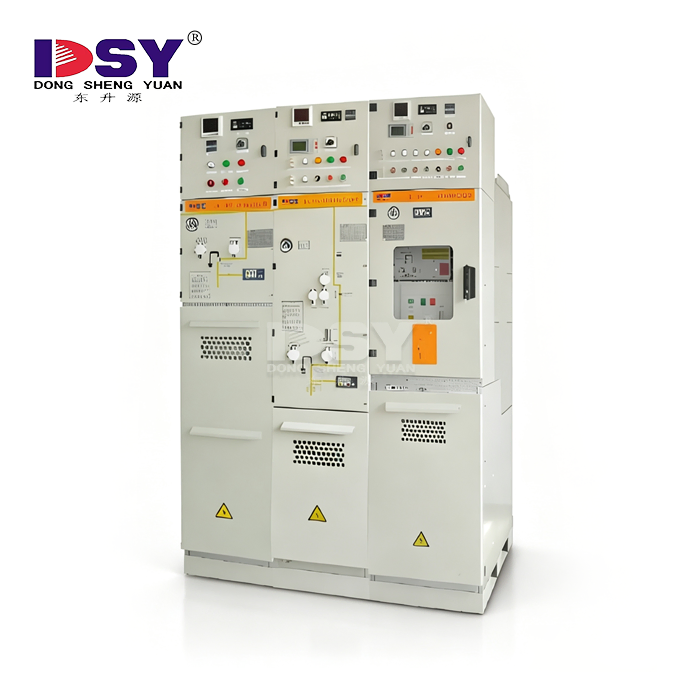
AIS stands for Air-Insulated Switchgear. The term describes medium-voltage equipment in which normal air at atmospheric pressure provides the insulation between live conductors and the grounded enclosure, instead of SF6 gas or epoxy resin. Each functional unit is a metal-armored cabinet with compartments for the busbar, the withdrawable vacuum circuit breaker, and cable terminations.
A Physical Barrier Between People and Live Parts
The safety logic is straightforward. Every live conductor sits behind earthed steel. The enclosure carries an IP4X protection rating, which blocks tools, wires, and small objects from reaching energized parts. Doors cannot be opened while the circuit is live because the interlock system physically blocks them. An untrained person who walks into the substation room can touch the cabinet but cannot touch electricity.
Compare this with older open busbar designs still operating in some plants, where bare conductors run within reach of anyone on a ladder. Retrofitting those rooms with enclosed Medium Voltage Switchgear removes the contact hazard at its source.
How AIS Compares With GIS and Older Designs
Procurement teams on Belt and Road projects often weigh AIS against gas-insulated switchgear (GIS). Both can be safe; the trade-offs sit elsewhere. The comparison below draws on manufacturer technical data and standard requirements.
|
Factor |
Indoor AIS Switchgear |
GIS |
|
Insulation medium |
Air at atmospheric pressure — no greenhouse gas |
SF6 gas, roughly 23,500× the global warming potential of CO2 |
|
Footprint |
Larger, needs a wider substation room |
Very compact, suits tight urban sites |
|
Maintenance |
Visual, tool-based, on-site inspection and repair |
SF6 handling requires certified specialists and gas recovery |
|
Initial investment |
Lower — typically a fraction of GIS cost |
Roughly 2–3× the AIS price for the same rating |
|
Fault handling |
Vacuum interruption in a withdrawable breaker |
SF6 interruption inside a sealed tank |
For most industrial buildings, photovoltaic plants, and municipal projects where floor space is available, AIS delivers equal protection at lower cost and with simpler after-sales logistics — spare parts are globally available, and no gas handling is involved for Medium Voltage Switchgear. GIS earns its premium only where space or environment forces it.
What Protective Features Are Built Into Indoor AIS Switchgear?
Modern Indoor AIS Switchgear stacks several protective layers into one assembly. Each layer addresses a different failure mode, from routine overloads to catastrophic internal arcs.
Vacuum Interruption That Quenches Arcs in 48 ms
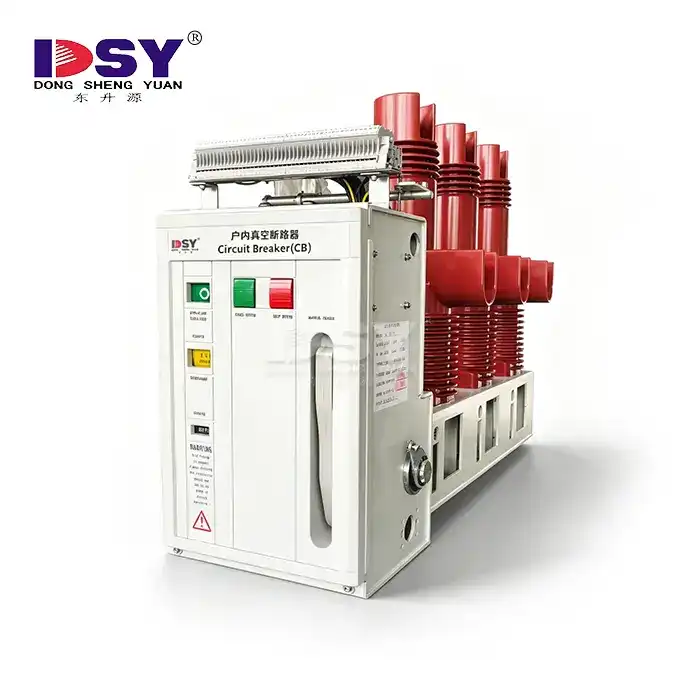
The circuit breaker in Indoor AIS Switchgear is the heart of fault protection. DSY equips its panels with a withdrawable handcart-type vacuum circuit breaker that extinguishes an arc in approximately 48 milliseconds — about eight times faster than a human blink. Inside the vacuum bottle, contacts separate with no air to ionize, so the arc collapses at the natural current zero rather than persisting and feeding a fire. Speed matters for both safety and asset life. The faster a fault clears, the less thermal energy flows into cables and busbars, and the lower the arc flash incident energy at the panel front. A breaker rated for 50 kA short-time withstand over 4 seconds gives the protection system room to discriminate before tripping, which keeps healthy feeders running while isolating only the faulted circuit.
Optional IAC AFLR Internal Arc Protection
Internal arc classification (IAC) is the industry's worst-case test. Laboratories deliberately ignite an arc inside the Medium Voltage Switchgear at rated fault current and verify that the enclosure contains it. The AFLR marking means an operator standing at the front, side, or rear of the panel is protected, with arc energy channeled through relief flaps away from personnel (CESI KEMA Labs, 2025). DSY offers IAC AFLR-certified construction as an option on its AIS line, recommended wherever personnel routinely work near energized panels. Third-party design standards used by major utilities, such as Transgrid's substation design standard, treat AFLR classification as a baseline requirement for metal-clad switchgear and cap arc fault clearance at 100 ms (Transgrid, 2023).
Intelligent Monitoring That Catches Faults Early
The newest safety layer is sensing. DSY panels support partial-discharge monitoring, infrared temperature sensing of busbar joints, and remote SCADA communication through a DTU gateway. Partial discharge — tiny insulation breakdowns that precede full flashover — can be trended months in advance, letting O&M teams schedule repairs during planned outages instead of reacting to failures at 2 a.m. This predictive capability converts safety from a passive barrier into an active early-warning system, and it is available as an add-on when panels are built to order.
How Does Air Insulation Support Safe Electrical Isolation?
Isolation in Medium Voltage Switchgear means creating a verifiable gap in the circuit so that a person can work on downstream equipment with certainty that it cannot become live. Air insulation makes this gap visible, inspectable, and testable.
Why Dry Air Beats SF6 for Safety and Sustainability
Air-insulated designs carry no pressurized gas system. There is no gas density monitor to fail, no pressure relief device to service, and no SF6 leak to manage. SF6 is an excellent insulator, but it is also a potent greenhouse gas with a global warming potential of roughly 23,500 times that of CO2. Regulations on SF6 handling keep tightening across Europe and parts of Southeast Asia, which affects end-of-life decommissioning costs. DSY's eco-friendly approach extends across its product range — the company uses dry air and 99.99% nitrogen insulation per GB/T 8979-2008 in its sealed products — making the AIS line a lower-risk choice for projects with sustainability mandates or carbon reporting requirements.
Visible Air Gaps Make Isolation Verifiable
When a withdrawable breaker in Medium Voltage Switchgear is racked out to the test position, the physical separation between the fixed contacts and the truck contacts is an air gap you can see and measure. A worker can verify isolation with eyes and a test instrument before applying grounding. Gas-insulated or fully sealed designs do not offer that visual confirmation to the same degree because live parts sit inside a sealed tank. For O&M teams that must document lockout-tagout evidence for audits, the visible gap in Indoor AIS Switchgear shortens the verification step and reduces procedural disputes during commissioning — a real pain point for contractors facing acceptance inspections.
How Do Circuit Breakers Improve Fault Protection?
A circuit breaker does two jobs: it carries load current continuously for decades, and it interrupts fault current within cycles when something goes wrong. Both jobs protect the distribution system.
Breaking Up to 50 kA Faults in Cycles
DSY's AIS panels carry bus current ratings from 630 A to 4000 A, and short-time withstand ratings from 20 kA up to 50 kA for 4 seconds. What that means in practice: a bolted fault near the switchgear — the kind that vaporizes tools and welds busbars — is interrupted before the enclosure itself is compromised. The vacuum interrupter inside the handcart breaker performs this duty repeatedly, unlike a fuse that must be replaced after every operation. After a fault, the breaker can be reset and the circuit re-energized within minutes, which matters for plants where downtime is measured in thousands of dollars per minute.
Coordination With Modern Protection Relays
The breaker is only as smart as the relay controlling it. DSY integrates protection relays from Schneider, ABB, or Eaton according to project specifications, allowing time-graded coordination across the network. Zone-selective interlocking between panels can cut fault clearing times at the main incomer, directly lowering arc flash incident energy throughout the switchboard. Relay settings, wiring diagrams, and test certificates are delivered with every project — a documentation package that commissioning engineers on Belt and Road projects consistently rank among their top acceptance requirements.
How Does Compartmentalization Limit Arc Fault Damage?
Compartmentalization is the structural feature that turns a catastrophic event into a contained one. In metal-clad construction, each functional unit is divided into separate grounded compartments: busbar, breaker, cable, and low-voltage instrument sections.
Metal Armor That Contains the Blast
When an arc ignites inside one compartment, the metal partitions confine the pressure and heat to that section. Adjacent panels keep operating. IEC 62271-200 defines this rigorously through partition class PM (metal partitions between the opened accessible compartment and live parts) and loss-of-service-continuity classes — LSC2B construction allows a single panel to be maintained while the busbar and neighboring panels stay energized (IEC, 2021). The pressure relief channels direct hot gases upward and out through designated vents rather than through a door facing an operator. This is the engineering difference between a contained fault and a substation fire that takes down a whole facility.
One Failed Panel Does Not Mean a Failed Project
For an EPC manager, compartmentalization in Indoor AIS Switchgear is also a schedule protection feature. If a cable termination fails in one outgoing panel, the repair touches one cubicle. The remaining feeders — often a dozen or more in a typical lineup — continue supplying the load. DSY's modular layout supports flexible combinations of incoming units, outgoing units, busbar sections, PT cabinets, and capacitor cabinets, so a damaged or reconfigured bay can be swapped without redesigning the switchboard. Downtime shrinks from days to hours, and the project's power availability guarantees survival of a single equipment failure.
What Role Does Interlocking Play in Operator Safety?
Interlocks are the mechanical rules of the switchgear. They make dangerous operation sequences physically impossible, regardless of who is standing in front of the panel. DSY equips every cabinet with the complete "five-proof" interlock system standard in Chinese and international practice.
The Five-Proof Interlock System Explained
The five proofs are the five classic ways operators get hurt, each blocked by a mechanical or electromechanical lock. Here is what each proof prevents in daily operation:
- Preventing closing or opening the breaker by mistake. The breaker cannot be operated from the panel unless it is correctly seated in the working or test position, so a breaker floating between contacts can never carry or interrupt load. This single lock eliminates a whole family of misoperation accidents during commissioning and switching rounds.
- Preventing the operation of the isolating contacts under load. The handcart cannot be racked in or out while the breaker is closed because the mechanism physically binds. Drawing out a closed breaker would create an arc at the isolating contacts — the interlock removes that possibility before the operator touches the handle.
- Preventing earthing an energized circuit. The grounding switch cannot close while the circuit is live, so a worker applying grounds for maintenance cannot bolt a short onto an energized busbar. This proof directly addresses the "unexpected contact with energy" category that accounts for 20% of U.S. electrical fatalities (ESFI, 2026).
- Preventing energizing a circuit while grounds are applied. Conversely, the breaker cannot close while the grounding switch is engaged, protecting the switching operator from closing onto a bolted earth — an event that would produce maximum fault current at the worker's position.
- Preventing entry into energized compartments. Compartment doors stay locked while the associated circuit is live, blocking access to busbars and terminals by anyone, trained or not. This is the proof that protects the 70% of victims who hold non-electrical roles and never received safety training.
Together, these five mechanical rules encode decades of accident investigation into steel and linkages. No procedure, sign, or training course enforces itself as reliably as an interlock that simply will not move.
Why Mechanical Beats Procedural
Every HSE manager knows the gap between written procedures and 3 a.m. shift behavior. Mechanical interlocks close that gap. They do not depend on the operator reading the manual, remembering the training, or resisting schedule pressure. When a rushed technician pulls the wrong handle, the interlock stops the sequence. That is why specifications from utilities and large industrial clients list complete five-proof interlocking as a mandatory acceptance item, and why DSY verifies every interlock function during factory testing before shipment.
How Can Indoor AIS Switchgear Simplify Safe Maintenance?
Maintenance safety is where switchgear design pays back over a 30-year service life. The withdrawable breaker architecture turns what used to be a shutdown into a swap.
Withdrawable Breakers and LSC2B Service Continuity
The handcart design lets a technician roll the vacuum breaker out of its compartment without touching busbar connections. The breaker can be tested, serviced, or replaced on a bench, away from energized equipment, and then rolled back in. Under LSC2B classification, other panels in the lineup remain live and loaded throughout the work (IEC, 2021). Maintenance windows shrink, lockout-tagout scope narrows to one cubicle, and exposure time near energized parts drops sharply. DSY also supplies QR-code installation and maintenance instructions on every cubicle, so the correct procedure travels with the equipment for its whole life — a small feature that prevents the "lost manual" problem O&M teams know too well.
Case Study: Hanoi Yen Xa Sewerage Treatment Plant, Vietnam
A concrete example shows how these features perform on a live Belt and Road project. Dong Sheng Yuan supplied medium-voltage distribution panels for the Yen Xa sewerage treatment project in Hanoi, Vietnam — a municipal wastewater scheme serving more than two million residents. According to DSY project records, the switchgear scope covered incoming, outgoing, and measurement panels configured to the site's single-line diagram, with protection relays integrated per the consultant's specification.
Three outcomes stand out from the commissioning and handover phase. Every panel passed the client's acceptance tests on the initial submission, with no rework cycle — a direct result of complete factory testing and full documentation packages shipped with the equipment. Partial discharge levels measured below 10 pC across the lineup, confirming insulation integrity well within the limits that O&M teams use for condition-based maintenance planning. And across the extended construction and commissioning period, the site recorded zero electrical safety incidents involving the switchgear, with interlock tests verified function-by-function in front of the client's engineers. For projects in Vietnam and neighboring markets where acceptance delays cascade into penalty clauses, that documentation-led approach is the difference between a clean handover and a contested one.
Which Standards Ensure Indoor AIS Switchgear Safety?
Standards convert "trust us" into "prove it." They define the tests a panel must pass before it deserves a place in your substation.
IEC 62271-200 and Its Chinese Twin, GB/T 3906
IEC 62271-200 governs AC metal-enclosed switchgear above 1 kV and up to 52 kV. It specifies temperature rise limits, insulation levels, short-circuit ratings, partition classes, internal arc classification, and the test methods behind each rating (IEC, 2021). The Chinese national standard GB/T 3906 mirrors these requirements for 6 kV to 40.5 kV equipment, and GB/T 11022 covers the common high-voltage switchgear specifications. A panel of Indoor AIS Switchgear certified to both frameworks satisfies consultants working under either regime — valuable for Belt and Road projects where the EPC contractor, the financing bank, and the end utility may reference different standards. Circuit-breaker performance follows IEC 62271-101, which defines the making and breaking tests that back the 50 kA ratings on DSY's nameplates.
Why Type Testing at KEMA-Style Labs Matters
A rating printed on a datasheet means nothing until an accredited laboratory has verified it. DSY's designs are type-tested at KEMA-style independent laboratories, where internal arc tests deliberately ignite faults at full rated current to prove containment (CESI KEMA Labs, 2025). Production panels then pass through DSY's in-house quality chain — temperature-rise rigs, partial-discharge test sets, shielded-room withstand-voltage testing, and mechanical property verification — before shipment. The company holds ISO 9001:2015, ISO 14001, and ISO 45001:2018 certifications, plus 60+ national patents, including 11 invention patents, and serves as a qualified supplier to China Southern Power Grid and State Grid Corporation of China. The companion track record — Tianjin National Games, Hangzhou G20 Summit, Chengdu Metro, and the Siem Reap water supply project in Cambodia — shows the same panels surviving high-scrutiny, deadline-critical deployments. OSHA's electrical standards for equipment installation and safe work practices add the workplace layer in markets that follow U.S. conventions (OSHA, 2025).
How Does Indoor AIS Switchgear Support Safer Power Distribution?
Safety ultimately shows up in operating results: fewer incidents, shorter outages, lower lifetime cost. This section connects the hardware features to outcomes across the applications DSY serves.
Three Real-World Application Scenarios
Where does this equipment earn its keep? These scenarios mirror projects DSY has delivered across its 20+ country export footprint.
Photovoltaic and energy storage plants. A solar farm in Southeast Asia feeds dozens of inverters into a collector switchboard at 24 kV. Fault duty is high, and remote sites mean the nearest qualified technician may be hours away. AIS panels with withdrawable vacuum breakers let site staff swap a suspect breaker in under an hour, while DTU-based remote monitoring lets DSY engineers in Shenzhen read panel status and partial-discharge trends and guide the local team — turning a potential week-long outage into a same-day recovery.
Data centers. A hyperscale facility in the Middle East runs 24/7 with redundancy measured in "nines." Compartmentalized LSC2B construction in Indoor AIS Switchgear allows single-panel maintenance without dropping the parallel feed, and the SF6-free air-insulated design simplifies fire-code and sustainability reviews that data center operators face in the region. IP4X enclosures and interlocked doors keep the unavoidable stream of non-electrical contractors safe in shared electrical rooms. Municipal infrastructure. The Hanoi Yen Xa sewerage project described above and the Siem Reap water supply project in Cambodia show the pattern: public infrastructure funded by international lenders demands complete test reports, certified ratings, and acceptance-ready documentation. DSY's in-house manufacturing and OEM/ODM flexibility — custom voltage from 1 kV to 40.5 kV, current ratings to 4000 A, short-circuit levels to 40 kA, and nameplates in the client's language — close the documentation gaps that cause acceptance risk.
Total Cost of Ownership and the Safety Payback
Cheap switchgear is expensive. A lifecycle view over a 30-year design life shows where the money goes. AIS avoids SF6 gas servicing and end-of-life gas recovery costs. The withdrawable breaker architecture cuts planned maintenance labor and eliminates the specialist callouts that sealed designs require. Modular construction means a single failed bay is repaired, not the whole board. And one prevented arc flash incident — averaging USD 1.5 million in medical costs alone (Atom Power, 2024) — pays for the entire switchgear line several times over. Add stable 15–30-day lead times on stock designs and 30–45 days on custom builds, with FOB, CIF, and DAP shipping through Yantian Port, and the delivery risk that inflates EPC contingencies shrinks as well. Safe equipment is not a cost center; it is the cheapest schedule insurance you can buy.
Conclusion
Indoor AIS Switchgear improves power distribution safety through layered, verifiable engineering: grounded metal armor and IP4X enclosures that separate people from energy, vacuum breakers that clear 50 kA faults in about 48 ms, compartmentalized construction that contains arc faults to a single bay, and five-proof interlocking that makes dangerous operations physically impossible. Air insulation adds visible, verifiable isolation and eliminates SF6 handling, while intelligent monitoring options catch insulation degradation before it becomes a failure. These are not abstract benefits — injury data shows 70% of electrical fatalities strike non-electrical workers who cannot be trained out of risk, only engineered out of it (ESFI, 2026). For switchgear assemblers, EPC companies, and procurement teams across Belt and Road markets, the specification decision is simple: demand type-tested, interlocked, compartmentalized Medium Voltage Switchgear with complete documentation, and hold your supplier to it.
FAQ
1. What does AIS mean in switchgear, and how does it differ from GIS?
AIS means Air-Insulated Switchgear — medium-voltage equipment where normal atmospheric air insulates the live conductors from the grounded metal enclosure. GIS (gas-insulated switchgear) performs the same function inside sealed tanks filled with SF6 gas. AIS cabinets are larger but cost significantly less, typically a fraction of the GIS price for the same rating, and they need no gas-handling specialists for maintenance (ABB, 2024). Both types can achieve high safety ratings, including internal arc classification. AIS is generally the better choice where floor space is available and lifecycle simplicity matters.
2. Is indoor AIS switchgear suitable for photovoltaic plants and data centers?
Yes, both are core applications. DSY's AIS panels are engineered for factory buildings, photovoltaic and energy storage sites, data centers, and municipal distribution. In PV plants, the high fault duty and remote locations favor withdrawable vacuum breakers that site staff can service quickly, paired with DTU remote monitoring for off-site engineering support. In data centers, compartmentalized LSC2B construction permits single-panel maintenance without interrupting parallel feeds, which protects the redundancy targets that data center clients demand.
3. What exactly is the five-proof interlock system?
It is a set of five mechanical and electromechanical safeguards built into the switchgear that block the classic misoperation sequences: operating the breaker in the wrong position, racking the handcart under load, closing the grounding switch on a live circuit, energizing a grounded circuit, and opening doors to energized compartments. Each proof is enforced by hardware — linkages and locks that physically will not move when the sequence is wrong. The system is standard on DSY panels, and every interlock function is verified during factory testing.
4. How often does indoor AIS switchgear need maintenance?
Routine care is light compared with gas-insulated alternatives. Recommended practice is an annual visual inspection and cleaning, with mechanism lubrication and contact-resistance checks on a two-to-three-year cycle, depending on switching frequency and environment. Partial-discharge and temperature monitoring, where installed, convert this calendar-based schedule into condition-based maintenance, often extending intervals further. The withdrawable breaker design means major servicing happens on a bench, not inside an energized panel, which cuts both risk and labor hours.
5. Can indoor AIS switchgear pass third-party internal arc testing?
Yes. DSY offers optional IAC AFLR-certified construction, tested in the internal arc programs that independent laboratories run according to IEC 62271-200 (CESI KEMA Labs, 2025). The AFLR marking confirms that a person standing at the front, side, or rear of the panel is protected during an internal arc event at rated fault current, with pressure and hot gases directed through relief channels away from personnel. Utilities and major industrial clients increasingly list AFLR as a procurement requirement rather than an option.
6. What lead times and documentation should international buyers expect?
Stock configurations ship in 15–30 days; custom designs built to your single-line diagram take 30–45 days. Every order includes a full documentation package: type-test reports, factory test certificates, mechanical and electrical drawings, relay setting records, and bilingual nameplates and manuals where required. OEM/ODM services cover voltage classes from 1 kV to 40.5 kV, current ratings up to 4000 A, enclosure color and logo, protection-relay brand selection, and packaging. Shipping supports sea, air, and multimodal routes under FCA, FOB, CIF, or DAP terms, backed by remote after-sales support and spare-parts supply.
Ready to Specify Safer Medium Voltage Switchgear for Your Next Project?
Choosing Indoor AIS Switchgear is choosing verified protection: IEC 62271-200 type-tested panels, complete five-proof interlocking, optional IAC AFLR arc containment, and documentation your acceptance engineers will approve the moment they open the file. As a Medium Voltage Switchgear supplier with 20+ years of manufacturing experience and installations across 20+ countries, Dong Sheng Yuan backs every panel with in-house production, KEMA-style type testing, and 24/7 remote support. Email [email protected] with your single-line diagram and project schedule, and our engineering team will return a tailored configuration, quotation, and compliance checklist within two working days to explore the full product range.
References
1. Electrical Safety Foundation International (ESFI). (2026). Workplace Injury and Fatality Statistics, 2011–2024. https://www.esfi.org/workplace-injury-and-fatality-statistics/
2. International Electrotechnical Commission (IEC). (2021). IEC 62271-200:2021 — High-voltage switchgear and controlgear, Part 200: AC metal-enclosed switchgear and controlgear for rated voltages above 1 kV and up to 52 kV. https://webstore.iec.ch/en/publication/6168
3. CESI KEMA Labs. (2025). Internal Arc Testing of Switchgear Assemblies — IEC 62271-200, IEC 62271-202, IEEE Std C37.20.7. https://www.cesi.it/app/uploads/2025/08/KEMA-LABS-Flyer-ARC-TEST-A4-0425.pdf
4. ABB. (2024). ZX0.2 Gas-Insulated Medium Voltage Switchgear — Technical Catalog (1VBA680503P0102). https://library.e.abb.com/public/f034f9255fa4470883aaedd420245f94/1VBA680503P0102_PTK_000_17.pdf — cited in the AIS versus GIS comparison and air insulation sections.
5. Transgrid. (2023). Substation Primary Design Standard— Internal Arc Classification Requirements for Metal-Clad Switchgear. https://www.transgrid.com.au/media/zgogqoqg/1-1-substation-primary-design-standard-rev-2.pdf
6. Atom Power. (2024). What Is Arc Flash? Causes, Dangers, and Why Traditional Protection Isn't Enough. https://www.atompower.com/post/what-is-arc-flash-causes-dangers-and-why-traditional-protection-isn-t-enough
About the Author
Kimball manages international B2B projects for medium-voltage switchgear across power distribution, renewable energy, and infrastructure markets. He has spent years guiding EPC contractors, switchgear assemblers, and procurement teams through specification, compliance testing, and acceptance on Belt and Road projects. His focus: matching IEC- and GB-certified equipment to real site conditions, on schedule, with documentation that passes the audit the moment it arrives.
YOU MAY LIKE
_1791601032136.webp "Eco-Friendly Gas Insulated Switchgear")
RELATED BLOGS