Dongshengyuan Outdoor Medium-Voltage Air-Insulated Switchgear (AIS): O&M Guide and Selection Solutions
Exported to 20+ countries | Dual IEC 62271 / GB/T certification | Full range from 7.2kV to 40.5kV
Certifications: ISO 9001 · ISO 14001 · ISO 45001 · IEC 62271-200 · IEC 62271-100 · GB/T 11022, GB/T 3906
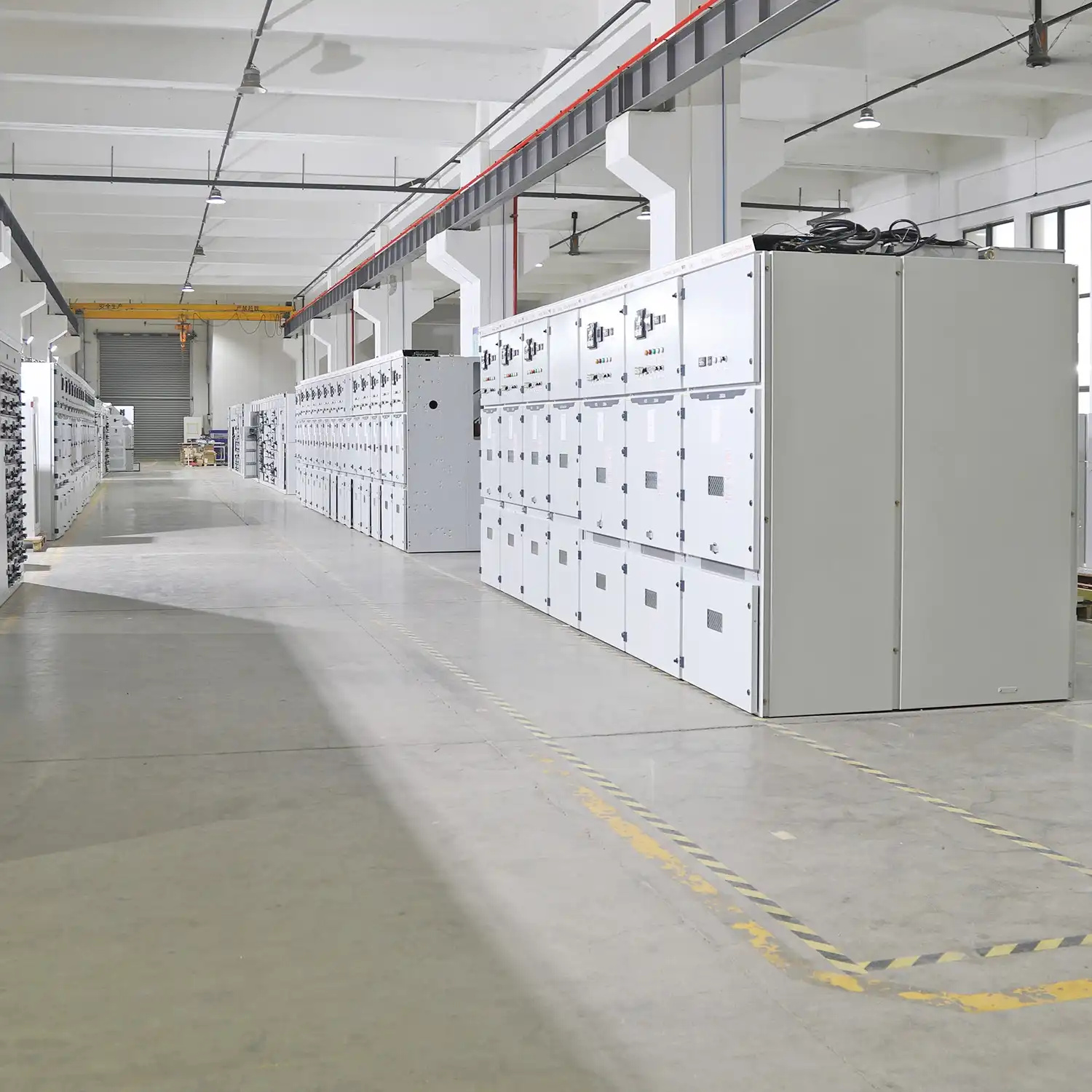
Why Are the O&M Costs of Conventional Outdoor Switchgear Always So High?
More than 80% of outdoor medium-voltage switchgear failures stem from environmental attack and design mismatch. The industry commonly adopts a makeshift retrofit of “indoor cabinet + rain canopy,” whose enclosure protection is only IP2X and completely unable to withstand long-term attack from humidity, salt spray, dust, and temperature cycling. The result is frequent maintenance, heavy downtime losses, and a persistently high life-cycle cost.
Industry Data
· One unplanned outage = an average of 261 hours of downtime ≈ more than 10 days of lost production
· Humidity accounts for 30% of insulated busbar failures — IEEE Std 493-2007 (Gold Book)
· Corroded fasteners cause 23% of unnecessary emergency call-outs — DSY 2025 global O&M statistics for 214 cabinet groups
Dongshengyuan outdoor AIS switchgear is tailored for harsh outdoor conditions and optimized across the board, from enclosure protection and internal environmental control to intelligent remote monitoring. 20-year life-cycle cost is more than 40% lower than conventional solutions, and it resolves outdoor O&M pain points at the root through four core technical advantages.
I. Four Core Technical Advantages (Pain Point – Solution – Benefit)
1. Sealed stainless steel enclosure: never repaint, block corrosion at the source
- Pain point: Painted carbon steel enclosures need repainting within 3–4 years; bolt corrosion and seal failure are the main causes of water ingress
- Solution: 304 stainless steel enclosure as standard, with 316 stainless steel optional for coastal/chemical areas; IP55 protection for the whole cabinet (per IEC 60529); one-piece EPDM gasket weather-resistant from -40℃ to 120℃; all-stainless-steel fasteners to avoid galvanic corrosion; sloped roof plus a 300mm raised base for active drainage
- Benefit: Achieves C4 corrosion resistance; the enclosure never needs repainting, and enclosure-related failures are reduced by 80%
2. Active anti-condensation system: humidity failures reduced by 75%
- Pain point: Day–night temperature swings cause condensation inside the cabinet and form conductive paths along insulation surfaces, the number one cause of busbar flashover
- Solution: Every compartment is equipped as standard with a PTC heating module and humidity sensor under intelligent closed-loop control, keeping the cabinet temperature at least 5K above the dew point; a heater-fault early-warning mechanism is included
- Benefit: 2025 field measurements: average annual humidity failures fell from 1.24 per cabinet to 0.31 per cabinet, a 75% reduction in failure rate
3. DTU intelligent remote monitoring: 60% fewer on-site inspections
- Pain point: Unattended sites involve long commutes, high inspection costs, and delayed fault detection
- Solution: An optional DTU (data transmission unit) uploads temperature, humidity, and circuit breaker status in real time over cellular/wireless networks; it can connect to SCADA or cloud platforms; trend analysis based on baseline data predicts failures
- Benefit: On-site inspections reduced by 60%, fault early-warning accuracy above 90%, shifting from reactive emergency repair to proactive planned maintenance
4. Modular all-scenario design: suited to every condition from inland to high altitude
- Pain point: Standard equipment cannot match special scenarios such as high altitude and heavy corrosion, and on-site modification is risky
- Solution: Fully functional compartments that can be flexibly combined; vacuum circuit breaker plus air-insulation technology with zero SF₆ greenhouse gas; five-fold mechanical interlock protection; dedicated increased clearances and current derating for high altitude
- Benefit: One cabinet covers the full voltage range from 7.2kV to 40.5kV, with no on-site modification and a 30% shorter commissioning period
II. What Makes Outdoor AIS Switchgear Hard to Maintain?
The outdoor AIS switchgear itself is usually not the core maintenance challenge. The difficulty of O&M comes mainly from four factors outside the equipment: accessibility for inspection, completeness of technical documentation, the expertise of O&M personnel, and a mismatch between the original design and outdoor conditions.
1. Travel convenience and commute time make up the main part of real costs
A routine inspection of a small-to-medium MV switchgear lineup typically takes only 30–45 minutes on site, but travel often takes far longer. A 2025 DSY survey of 214 outdoor cabinets across 17 sites showed a median round-trip time of 3.6 hours per site visit, and 71% of sites had no full-time technician on site.
This is the core driver behind every O&M optimization: one site visit typically costs half a day, so the best approach is coordinated planning that completes multiple O&M tasks in parallel during a single visit.
2. Missing documentation turns small tasks into long ones
O&M teams commonly report the same problem: after a heater fails, no one can find the matching wiring diagram, part number, or thermostat settings, so a simple replacement turns into a prolonged investigation.
Every Dongshengyuan cabinet ships with a complete technical documentation package, including type test reports, wiring diagrams, a spare parts list with reorder numbers, and a QR code that can be scanned to watch installation guidance videos. Technical documentation is a practical O&M tool, not a formality for delivery.
3. Safety procedures make every task longer
On-site work on MV switchgear must follow Lockout-Tagout (LOTO) procedures, i.e., isolating, locking out, and tagging the power source to prevent anyone from energizing it by mistake. In addition, NFPA 70E requires an arc flash risk assessment and personal protective equipment (PPE) that meets arc-protection standards.
An internal inspection that would take 20 minutes can reach a total of 2 hours once the permit process is included — a requirement that is compliant and non-negotiable. It also means that external inspection items that can be completed without opening the door have very high efficiency value.
4. Design mismatch is the root cause
An indoor cabinet is not an outdoor cabinet. Indoor designs assume stable temperatures, no rainfall, and no UV exposure. For indoor installations, IEC 62271-200 specifies a minimum enclosure protection of only IP2X, which cannot keep out dust, insects, and heavy rain outdoors.
Many products currently marketed as “outdoor AIS switchgear” are essentially “indoor cabinets placed outside,” without systematic protective design for outdoor conditions.
III. How Does Weather Affect the Performance of MV Switchgear?
Outdoor AIS switchgear is exposed to weather through four pathways: heat, moisture, radiation, and atmospheric pollutants. Each produces specific degradation effects on different components.
1. Solar load and ambient heat raise conductor temperature
IEC 62271-1 sets the upper limit of ambient temperature in typical service conditions at 40℃, while in many regions the daily average ambient temperature can exceed 35℃. Under strong direct sunlight, a dark cabinet can run 15–20K above ambient at noon. Load current adds further Joule heating, pushing busbar connections to their thermal limits.
Insulation aging speed doubles for every 8–10K rise in temperature, so cabinets age much faster under high-temperature conditions than in normal-temperature environments.
2. Rain, splash water and standing water attack the least impermeable points first
Moisture enters through cable glands, door seals and roof-panel joints rather than penetrating the steel itself. An IP55 rating means protection against low-pressure water jets from any direction (per IEC 60529), but it takes effect only if all cable glands, vents and drain outlets meet the same protection level.
If cable entries are not marked with a protection rating, the rating of the entire enclosure is limited by that weakest component.
3. UV radiation and salt spray attack the enclosure itself
UV breaks down coatings, rubber seals, and cable sheaths; chloride ions in salt spray cause pitting in stainless steel and corrode bolted connections. ISO 12944-2 classifies atmospheric corrosivity from C1 to CX: C3 corresponds to urban and light industrial areas, and C4 to coastal and industrial areas with moderate salinity.
Dongshengyuan MV outdoor AIS switchgear is offered with C3 and C4 corrosion ratings, and C4 covers most coastal PV and wind farm scenarios in Southeast Asia and the Middle East.
4. High altitude reduces the dielectric strength of air
Above 1000m, the air becomes thinner, and creepage and clearance distances must be increased accordingly. Creepage distance is the shortest distance between two conductors along an insulating surface; air cooling capacity also declines, so the rated current must be derated.
For 40.5kV wind-farm step-up stations above 2000m, DSY uses a larger-clearance design matched with a derated continuous operating current. When making an inquiry, please provide the altitude of the project site (not of the factory) so the design can be matched precisely.
IV. Key Maintenance Challenges: Humidity, Corrosion, Dust and Temperature
Four failure modes contribute to the vast majority of equipment failures. The following describes how they act within MV switchgear compartments.
1. Condensation — the silent killer
Condensation occurs when the temperature of any internal surface falls below the dew point — the critical temperature at which air can no longer hold its water vapor. It typically occurs at sunrise, when day–night temperature differences are large (after a hot, humid day), and dampens insulators, busbar supports, and terminal blocks.
Once a conductive water film forms along a creepage path, surface discharge and flashover occur. According to IEEE Gold Book survey data, humidity exposure accounts for 30% of insulated busbar failures and is the leading confirmed causative factor.
2. Corrosion — erosion of safety paths
Door hinges, grounding bolts, cable terminals, and outdoor AIS switchgear operating mechanisms are all attacked by chloride-laden moisture. Corrosion raises joint resistance, higher resistance raises temperature, and higher temperature accelerates corrosion further, creating a vicious circle.
Analysis of DSY's 2025 failure records shows that rusted fasteners and grounding connections caused 23% of non-essential emergency call-outs, all at sites within 15km of the coastline or chemical facilities.
3. Dust and contaminants — turning moisture into a conductive medium
Dry dust is generally harmless, but moisture forms a conductive coating on dust accumulated on insulator surfaces, intensifying partial discharge (PD) activity. Partial discharge refers to tiny electrical discharges occurring inside or on the surface of insulation, which gradually degrade the material until it eventually breaks down.
According to IEEE Gold Book statistics, dust and contaminants are the second leading cause of busbar failures, accounting for 10% of insulated busbar failures and 19% of bare busbar failures.
4. Temperature cycling — damages seals and joints
Daily thermal expansion and contraction cycles loosen bolted joints and harden sealing gaskets. Operating under daily temperature cycles of 20℃ to 70℃ for three years leads to noticeable loosening of connections. Thermal imaging can identify this problem long before a failure occurs, so a sound inspection interval is essential.
It is recommended to complete bolt re-tightening before the hot season arrives, rather than after it.
Dust and moisture often go together, which explains why the O&M frequency required in tropical coastal areas differs significantly from that in inland deserts.
V. How Often Should Outdoor AIS Switchgear Be Inspected?
The inspection interval should depend on actual site conditions, not a fixed calendar convention. The 2023 edition of NFPA 70B has become a mandatory standard and ties infrared inspection frequency to equipment condition: every 12 months for Condition 1 or 2 equipment, shortened to every 6 months for Condition 3 equipment. ANSI/NETA MTS specifies the test methods and acceptance criteria for this work.
Practical O&M Interval Table
|
Task |
Interval |
On-site Time |
Responsible Personnel |
|
Roadside visual patrol |
Monthly; quarterly for unattended sites |
15–25 minutes per lineup |
On-site technician |
|
Infrared scan under load |
12 months; 6 months for Condition 3 |
1–2 hours per lineup |
Certified thermographer |
|
Inspection of heaters, thermostats, and humidity sensors |
Quarterly, plus one extra before the rainy season |
10 minutes |
On-site technician |
|
Inspection of enclosure, seals, and drain outlets |
Quarterly |
20 minutes |
On-site technician |
|
Insulation resistance and partial discharge screening |
24–36 months |
2–4 hours |
Testing specialist |
|
Circuit breaker mechanism maintenance |
60 months or by number of operations |
4–8 hours |
Factory-trained technician |
|
Life assessment and overhaul decision |
10–15 years |
Site-dependent |
Factory engineer |
Why 12 Months Should Be Treated as a Floor, Not a Target
The annual thermography baseline is set for cabinets in mild climates, clean and dry, with very low load. If the same cabinet is deployed at a coastal PV site (salt spray, 90% relative humidity), a reasonable inspection interval would be 6 months.
Dongshengyuan recommends: for C4 corrosion-class sites, a weekly patrol and a full inspection every six months. “Outdoor AIS switchgear can well fail between two annual inspections.”
New sites require a baseline scan
During the commissioning period, baseline data for thermal performance and insulation resistance must be established. Without a baseline, a measured 65℃ at a busbar joint means nothing; with a baseline comparison, you can see that the joint has risen 18K within a year and schedule a planned outage for repair, rather than an emergency response after failure.
VI. Key Inspection Points for Reliable Operation of Outdoor Switchgear
The effectiveness of an inspection depends on the quality of the checklist. The following six core inspection points can identify roughly 80% of potential faults before most of them develop into outages.
1. Enclosure, seals and drainage
- Check welds for rust streaks
- Check door gaskets for cracking or flattening
- Clear blocked drain holes and remove standing water from the cable trench
- Confirm that the base raises the cabinet at least 300mm above the ground
- Doors should close evenly with no visible gaps
2. Anti-condensation heating system
- Confirm the heater is operating normally and the thermostat is set correctly
- Confirm humidity sensor readings are normal
- Check that the air temperature inside the cabinet always stays above the dew point, ideally with a 5K safety margin
- A heater failure cannot be detected directly from outside, and signs of failure usually appear only after about two months
3. Terminations and joints
- Under typical load, scan the temperature of busbar joints, cable terminals, and disconnect contacts
- Target readings should not exceed 40% of the rated value
- NFPA 70B requires action when the temperature exceeds the set threshold
- Common industry criterion: a temperature difference of 4–15K between similar components is regarded as a potential defect, and more than 15K as an emergency
4. Operating mechanism and interlocks
- Operate the mechanism manually and verify smooth movement
- Compare the cumulative number of operations against the manufacturer's service limit
- Verify the five-fold interlock functions: preventing closing on a fault, preventing jamming under load, preventing grounding of a live circuit, preventing energizing of a grounded circuit, and preventing entry into a live compartment
5. Grounding and surge protection
- Check grounding connections for corrosion and tightness
- Measure grounding resistance regularly
- Check the status of surge protective devices
- Outdoor MV switchgear is subjected to lightning stress, and a reliable grounding path keeps that stress away from personnel and electronic equipment
6. Cable terminations, vents and filters
- Every cable penetration must match the enclosure protection rating
- Check seals, filter condition, and all vents
- Blocked vents cause moisture to be trapped inside the sealed cabinet
- Damaged seals allow rainwater to run along the cable sheath into the terminations
VII. Preventive Maintenance Practices for MV Switchgear
Preventive maintenance of outdoor AIS switchgear is low-cost and can be carried out on schedule, while corrective maintenance after a failure is expensive and cannot be scheduled in advance. Widely cited switchgear survey data show that the average downtime per failure is close to 261 hours, equivalent to more than ten days of lost production.
1. Cleaning, torque and lubrication
- Clean insulators with certified solvents
- Re-torque bolted connections to the values specified on the drawings
- Lubricate mechanism bearings with the specified grade of grease
- The circuit must be de-energized, grounded, and locked out before work
- Never use abrasive tools on insulation surfaces
2. Electrical tests to detect latent damage
- Insulation resistance test: Quickly provides a general survey of equipment health
- Partial discharge test: Detects internal voids, surface tracking, and surface contamination before flashover occurs, without requiring a power outage
- IEEE Gold Book data show that the root cause of the vast majority of switchgear bus, busway, and cable failures is insulation breakdown, so partial discharge screening on critical feeders offers a very high return on investment
3. Documentation and trend analysis
- Record and archive all test data in a unified way, noting date, load, ambient temperature, and site photos
- Trend analysis turns raw data into O&M decisions
- Dongshengyuan provides a standard maintenance log template; at sites with DTU monitoring modules installed, temperature and humidity data can be transmitted directly to your SCADA system or cloud dashboard
4. Spare parts you should keep on site
Recommended per 10 compartments: 1 anti-condensation heater, 1 thermostat, 1 set of door gaskets, several fuses, and 1 closing coil. These parts are inexpensive and lightweight, cover the vast majority of real fault scenarios, and can shorten a repair downtime of three weeks to same-day completion.

VIII. How to Prevent Condensation and Corrosion Inside Outdoor AIS Cabinets
Prevention is a decision to be made at the design stage. Four core measures achieve long-lasting protection at a cost far lower than the loss from a single unplanned outage.
1. Keep the internal temperature above the dew point
Dongshengyuan integrates heating and dehumidification modules as standard in every outdoor AIS switchgear compartment. A humidity sensor automatically switches the PTC heater on and off, keeping the cabinet air temperature roughly 5K above the dew point.
DSY's 2025 assessment data show that compartments with active anti-condensation control averaged only 0.31 humidity-related failures per cabinet per year, versus 1.24 for compartments without it, a 75% difference in failure rate.
2. Seal the enclosure, then protect the penetrations
For outdoor use, specify IP54 or IP55 protection in accordance with IEC 60529. EPDM gaskets are recommended — a synthetic rubber that stays flexible from -40℃ to +120℃ and resists UV and ozone. Avoid polyvinyl chloride (PVC) or foam gaskets.
Make sure every cable gland meets the same protection level; the overall waterproofing performance of the cabinet is determined by its entry point with the lowest protection rating.
3. Choose 304 or 316 stainless steel for the enclosure
DSY's standard outdoor enclosure uses 304 stainless steel with a corrosion-resistant sealing structure. For more corrosive coastal or chemical locations, a 316 stainless steel upgrade is available. Stainless steel avoids the frequent repainting that painted carbon steel requires in C4 environments.
DSY also offers an all-stainless-steel fastener solution, because a stainless steel enclosure paired with carbon steel bolts will still corrode at the bolts.
4. Place the cabinet where water can drain away
- Install on a concrete base at least 300mm above the finished grade
- Keep the factory-provided drain holes unobstructed
- Slope the cable trench away from the base and provide on-site drainage
- Keep vegetation and debris away from the cabinet
- In hot climates, add shading to reduce solar heat gain
- Ensure air circulates around the cabinet rather than flowing through it
Design takes priority over specification. A sealed stainless steel cabinet with active heating needs only a small fraction of the O&M effort of a painted indoor cabinet.
IX. Common Outdoor Switchgear Failures and How to Avoid Costly Downtime
The following are the failure modes most often encountered in the field, their root causes, early warning signs, and the corresponding preventive solutions.
Failure Mode Reference Table
|
Failure Symptom |
Root Cause |
Early Warning Signs |
Preventive Solution |
|
Insulator flashover |
Condensation water film and surface contamination |
Surface discharge activity, ozone smell |
Heaters with dew-point margin, IP55 sealing |
|
Busbar joint overheating |
Corrosion, loose torque, cyclic loading |
Thermal imaging values above baseline |
Torque checks, tin-plated joints, annual scans |
|
Mechanism jamming |
Dried-out grease, corrosion, moisture ingress |
Slow operation or increased noise |
Regular lubrication, sealed compartments |
|
Grounding path failure |
Corrosion of bolts and bolt heads |
Rising soil resistivity |
Stainless steel fasteners, regular measurement |
|
Animal or insect intrusion |
Unsealed openings, cable gaps |
Nests, gnawed insulation |
IP55 sealing, blanking plates, insect screens |
|
Cable termination failure |
Water leakage at the sheath, poor workmanship |
Elevated partial discharge at the termination |
Drip loops, heat-shrink terminations, partial discharge screening |
X. Case Studies
Case 1: 24kV coastal PV step-up station in Southeast Asia
A 50MW solar project installed 28 painted carbon steel MV cabinets under a rain canopy in 2023. In month 18 of operation, the operator logged 9 humidity-related inspections per year, and staff made 12 site visits a year.
DSY completed the replacement with 304 stainless steel outdoor AIS cabinets rated IP55, with built-in heating, EPDM gaskets, and rated seals. In the following year after the retrofit, humidity inspections fell to 1, planned visits dropped from 12 to 4, and the operator saves approximately US$18,600 a year in labor and travel costs.
Case 2: 40.5kV wind-farm collector station at 2200m altitude
Nine switchgear compartments sit at a ridge-top site where nighttime temperatures drop as low as -25℃, UV is intense, and no staff is permanently present. Weekly patrols consumed 190 technician hours a year.
DSY engineers supplied outdoor AIS switchgear with a high-altitude increased-clearance design and higher-capacity heating modules, and added DTU modules for remote temperature and humidity monitoring. After the retrofit, patrols changed to monthly, and site O&M is now based on trend-data analysis rather than experience-based guesswork.
Case 3: 12kV suburban feeder in a dusty inland town
A distributor installed 16 cabinets near an unpaved road to supply growing suburban customers. Clogged filters and dust accumulation on insulators led to two electrical tracking incidents within three years.
DSY delivered IP55 cabinets with labyrinth vents, along with a quarterly filter-replacement program. No tracking has occurred in the 26 months since commissioning, and each filter cleaning now takes only 15 minutes.
In early 2026, an O&M supervisor at a PV project in Vietnam summed it up during a joint site inspection: “We replaced the cabinets, but what really made the difference was dew-point margin control. Once the heaters kept the interior about 6 degrees above the dew point, the night patrols were cancelled, and my phone no longer rings in the middle of the night.”
XI. Choosing Weather-Resistant Enclosures for Long-Term Reliability
Enclosure material and protection design determine the O&M workload over the next 25 years. Procure on the basis of actual verified data, not merely nominal claims on a datasheet.
IP Ratings vs. NEMA Ratings
IEC 60529 defines the IP code system: the first digit indicates the degree of protection against solid ingress, and the second the degree of protection against water. IP54 provides dust and splash protection; IP55 adds protection against low-pressure water jets.
For MV switchgear complying with North American codes, NEMA 3R is suitable for general outdoor environments and NEMA 4X for corrosive locations. DSY outdoor cabinets ship with an IP43 or IP55 protection rating, with IP55 recommended for coastal and high-pressure wash-down areas.
Material Selection and Life-Cycle Cost
|
Option |
Applicable Corrosion Class |
Repainting Cycle |
Annual Maintenance Visits |
20-Year Cost Index |
|
Painted carbon steel, indoor design with canopy |
C3 |
Every 3–4 years |
12 |
168 |
|
304 stainless steel outdoor AIS, IP55, with heating |
C4 |
None required |
4 |
100 (baseline) |
|
316 stainless steel outdoor AIS, IP55, with heating |
C4–C5 |
None required |
3 |
111 |
|
Gas-insulated GIS outdoor kiosk |
C4 |
None required |
2 |
145 |
Outdoor AIS switchgear offers most users the best balance of maintainability, purchase cost and O&M cost. GIS has advantages in footprint and sealing, but its purchase cost is higher and it requires factory-trained specialist service. Ring main units (RMUs) suit compact secondary distribution scenarios with small, fixed loads.
Verify type test results, not label information
Ask suppliers for type test evidence per IEC 62271-200, covering dielectric properties, temperature rise, short-time withstand, partial discharge, and internal arc classification. The IAC test verifies the protection of personnel when an arc occurs inside the enclosure. The 2024 amendment tightened the IAC criteria and the requirements for earthing circuits.
Dongshengyuan products comply with IEC 62271-200, IEC 62271-100, GB/T 11022 and GB/T 3906, and hold ISO 9001:2015, ISO 14001 and ISO 45001:2018 certification.
Plan thermal performance together with sealing performance
A sealed design raises the internal temperature. Check the temperature-rise type test at the site ambient temperature, not test data at a room temperature of 25℃. DSY engineers perform current derating calculations for high-altitude and high-ambient-temperature sites, and sun shields can be added at locations with high solar load.
XII. How Does the Right MV Switchgear Manufacturer Reduce Maintenance Costs?
Before a purchase decision is made, a professional MV switchgear supplier will first assess your O&M workload. A reputable manufacturer will either help you optimize life-cycle O&M costs or directly provide a twenty-year all-inclusive O&M service.
1. Reduce maintenance tasks at the design source
- Anti-condensation heating system as standard, eliminating quarterly drying maintenance
- Stainless steel enclosure plus sealed design, with no periodic repainting needed
- Modular layout that allows a single functional unit to be isolated and operated without affecting adjacent compartments
- DSY provides synchronized outdoor installation services covering the full range of compartment types, including incoming, outgoing, busbar, and PT
2. Remote monitoring replaces manual patrols
DSY's optional unattended intelligent monitoring module transmits temperature, humidity, and circuit breaker status data via the cellular network or wirelessly through a DTU (data transmission unit), feeding the data stream into your SCADA system or cloud dashboard.
Sites using this system can typically cut on-site inspections by 60% while improving fault visibility. This value is especially significant for unattended PV and wind assets.
3. Complete documentation, spare parts and technical support
On request, you can obtain the complete environmental-adaptability test report for the MV switchgear, as well as technical drawings, lifting and installation guides, and a designated after-sales contact. DSY provides all of the above, along with remote after-sales support and OEM customization services.
The company holds more than 60 patents (11 of them invention patents) and has its own sheet-metal fabrication, welding, and testing workshops, ensuring customized solutions are delivered on time. Standard in-stock designs ship in 15–30 days, and custom orders are delivered in 30–45 days.
4. Customized design matched to the project
DSY adjusts the corrosion protection class, cabinet layout, and installation method to your terrain conditions and single-line diagram. Products cover voltages of 7.2–40.5kV, busbar currents of 630A–3150A, and a short-time withstand current of 40kA/4s.
Upfront customization means no on-site modification later; on-site changes often reveal problems only when acceptance risk has already formed.
5. Focus on total cost of ownership, not purchase price
Lower-priced cabinets usually mean painted enclosures, no heating, and no complete type test reports. The extra you pay for on-site service, repainting, and downtime will outweigh the amount saved at purchase many times over. The 20-year total cost must include service visits, spare parts costs, and downtime risk.
Therefore, in the vast majority of projects, outdoor AIS switchgear with a stainless steel enclosure offers better overall economics.
XIII. Conclusion
Outdoor AIS switchgear O&M is no longer difficult as long as three core conditions are met:
- The cabinet is made of stainless steel and is well sealed
- The temperature inside the cabinet stays continuously above the dew point
- Inspection intervals are set according to the actual condition of the equipment, not a fixed convention
According to IEEE records, humidity is the leading cause of MV busbar failures, and condensation is also the failure cause most easily avoided through sound design. DSY's 2025 assessment of 214 compartments shows that active anti-condensation management can reduce humidity-related defects by 75%.
Selection recommendations for coastal and industrial areas: Choose IP55 protection plus C4-class stainless steel, verify type tests in accordance with IEC 62271-200, and keep a small spare parts kit on site. Do this, and your outdoor AIS switchgear can move from monthly emergency repairs to quarterly routine inspections.
XIV.FAQ
Q1: How long does routine maintenance of outdoor AIS switchgear take?
A: A routine monthly inspection of a six-compartment lineup takes 15–25 minutes; an annual infrared scan takes 1–2 hours; and circuit breaker mechanism maintenance takes 4–8 hours per compartment. Travel time usually exceeds actual working time, so combining multiple tasks into one visit maximizes cost savings.
Q2: Can I install indoor MV switchgear outdoors under a canopy?
A: Please avoid this. Indoor designs assume no rainfall, no UV, and stable temperatures. IEC 62271-200 specifies only IP2X protection for indoor enclosures. A canopy can block direct rainfall, but it cannot block moisture, condensation, or wind-blown dust. You will end up paying higher hidden costs for it.
Q3: What IP rating should be specified for solar or wind sites in coastal areas?
A: Treat IP55 as the practical minimum. For wash-down scenarios or heavy salt-spray exposure, consider IP65. Ensure every cable gland is matched with seals of the same protection level. EPDM gaskets are an ideal choice for coastal environments; PVC and foam gaskets will harden and crack within a few years.
Q4: Does air-insulated switchgear require sulfur hexafluoride gas handling?
A: No. Air-insulation technology uses no sulfur hexafluoride gas, so you do not need to compile a greenhouse gas inventory, carry out gas handling procedures, or conduct leak detection. DSY outdoor AIS switchgear combines air-insulation technology with a dedicated outdoor vacuum circuit breaker, completely eliminating environmental-compliance work.
Q5: How many site visits can remote monitoring save?
A: Sites running DSY's DTU-based monitoring module can typically cut physical patrols by about 60%. Temperature, humidity, and circuit breaker status are monitored continuously rather than quarterly. The savings are most significant at unattended renewable energy sites, where each visit involves more than two hours of round-trip travel.
Q6: What spare parts should the O&M team keep in stock?
A: Per 10 compartments: 1 heater, 1 thermostat, 1 set of gaskets, 1 closing coil, and 1 set of fuses. This configuration covers the vast majority of real fault scenarios and avoids three weeks of downtime spent waiting for one small part.
XV. Next Step: Turn This Checklist into a Procurement Specification
Ready to move from a checklist-style approach to a formal technical specification? Send us your single-line diagram, altitude, environmental conditions, and corrosion class, and we will return a cabinet layout proposal, a maintenance plan, and a complete type test documentation package.
Dongshengyuan is a professional manufacturer of outdoor AIS switchgear with 20 years of production experience, and its products comply with IEC 62271-200, IEC 62271-100, GB/T 11022 and GB/T 3906.
Please send an email to: [email protected]. Our engineers will reply within 48 hours with a technical proposal and budget quotation.
References
1. IEC. IEC 62271-200:2021 — High-voltage switchgear and controlgear, Part 200: AC metal-enclosed switchgear and controlgear for rated voltages above 1kV and up to and including 52kV. IEC, 2021.
2. IEC. IEC 62271-200:2021/AMD1:2024 — Amendment 1: Including the 1s rule for Criterion 4 for internal arc, and refined earthing circuit rating provisions. IEC, 2024.
3. IEC. IEC 60529 — Degrees of protection provided by enclosures (IP Code), Edition 2.2 (1989+AMD1:1999+AMD2:2013). IEC, 2013.
4. NFPA. NFPA 70B, Standard for Electrical Equipment Maintenance, 2023 edition (mandatory standard that sets condition-based infrared inspection intervals). NFPA, 2023.
5. IEEE. IEEE Std 493-2007, Recommended Practice for the Design of Reliable Industrial and Commercial Power Systems (Gold Book), Appendix E: Contributing factors to switchgear bus failures. IEEE, 2007.
6. NETA. ANSI/NETA MTS, Standard for Maintenance Testing Specifications for Electrical Power Equipment and Systems. InterNational Electrical Testing Association.
About the Author
Kimball is the Medium-Voltage Division Manager at Dongshengyuan (DSY), with 12 years of experience in selection, commissioning, and troubleshooting of air-insulated switchgear, covering PV step-up stations, wind collector stations, and municipal feeder projects in Southeast Asia, the Middle East, and Africa. He works directly with EPC contractors and O&M teams on enclosure selection, condensation control, and inspection planning, and reviews DSY's type test documentation against IEC 62271-200 before every shipment.
YOU MAY LIKE
_1791601032136.webp "Eco-Friendly Gas Insulated Switchgear")
RELATED BLOGS